PPWR: European legislation on packaging
The Packaging and Packaging Waste Regulation (PPWR) is a piece of European legislation designed to drastically reduce packaging waste within the European Union. Within the floriculture chain, it calls for a clear division of roles, improved data flows and more sustainable packaging choices. The VGB and Royal FloraHolland are working together to represent the interests of growers and buyers.
Key dates
2025
11 February 2025: The Packaging and Packaging Waste Regulation (PPWR) comes into force.
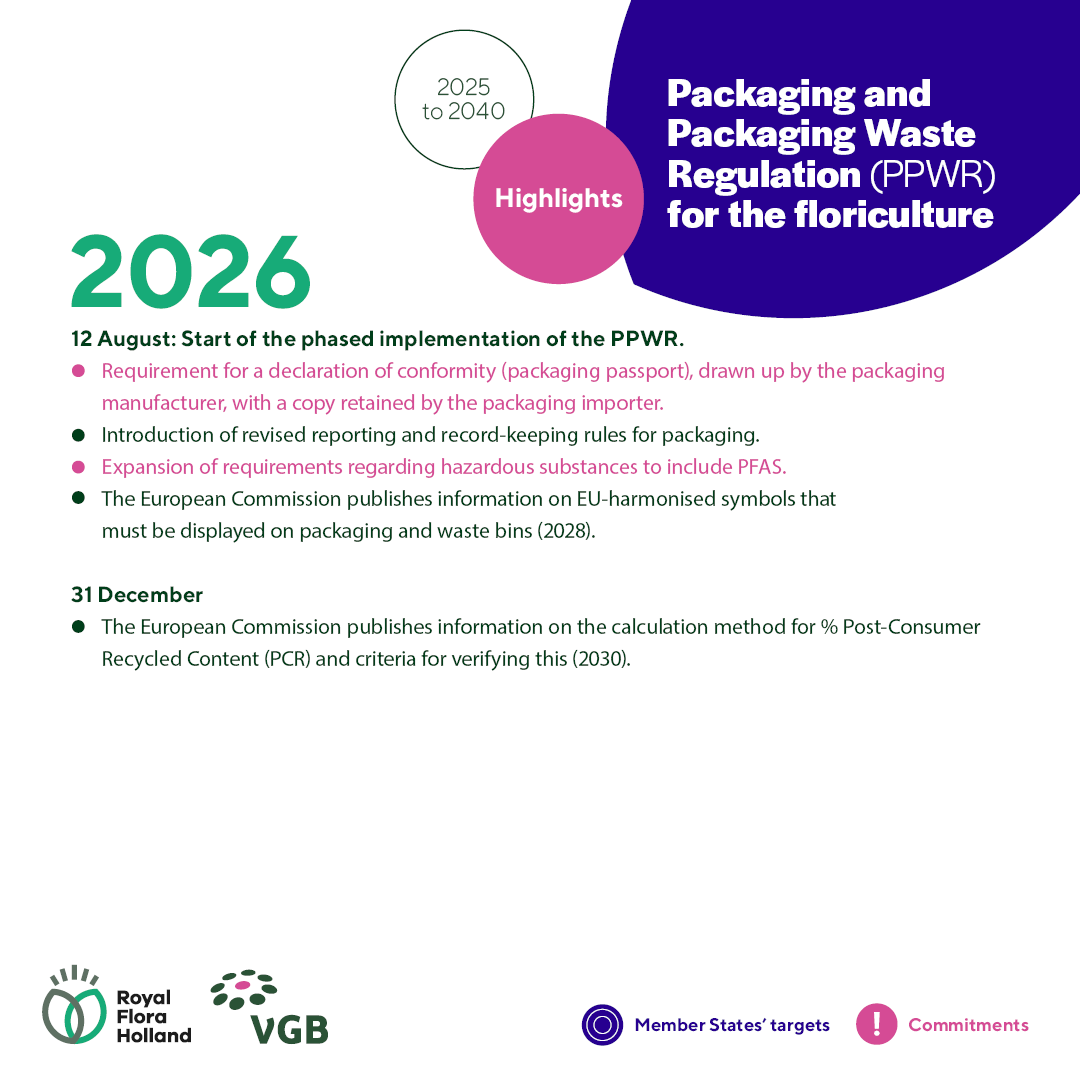
2026
2 August 2026: Start of the phased implementation of the PPWR:
- • Introduction of the requirement for a declaration of conformity (packaging passport), drawn up by the packaging manufacturer, with a copy retained by the packaging importer
- • Introduction of revised reporting and record-keeping rules for packaging
- • Expansion of requirements regarding hazardous substances to include PFAS
- • The European Commission publishes information on EU-harmonised symbols that must be displayed on packaging and waste bins (2028)
31 December 2026: The European Commission has published information on the calculation method for % Post-Consumer Recycled (PCR) content and the criteria for verifying it (2030)
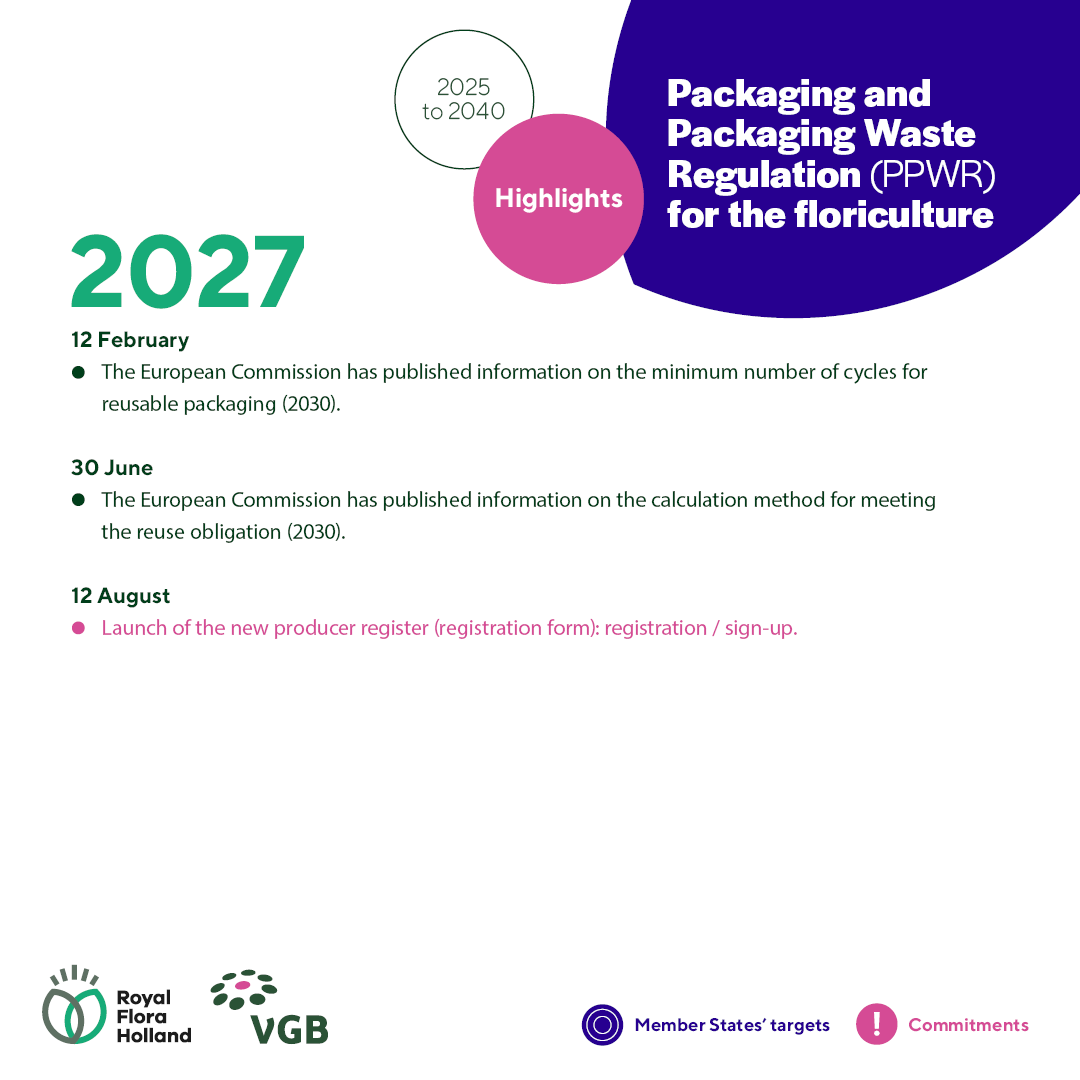
2027
12 February 2027: The European Commission publishes information on the minimum number of cycles for reusable packaging (2030).
30 June 2027: The European Commission publishes information on the calculation method for meeting the reuse obligation (2030).
12 August 2027: Launch of the new producer register (declaration form): registration/sign-up.
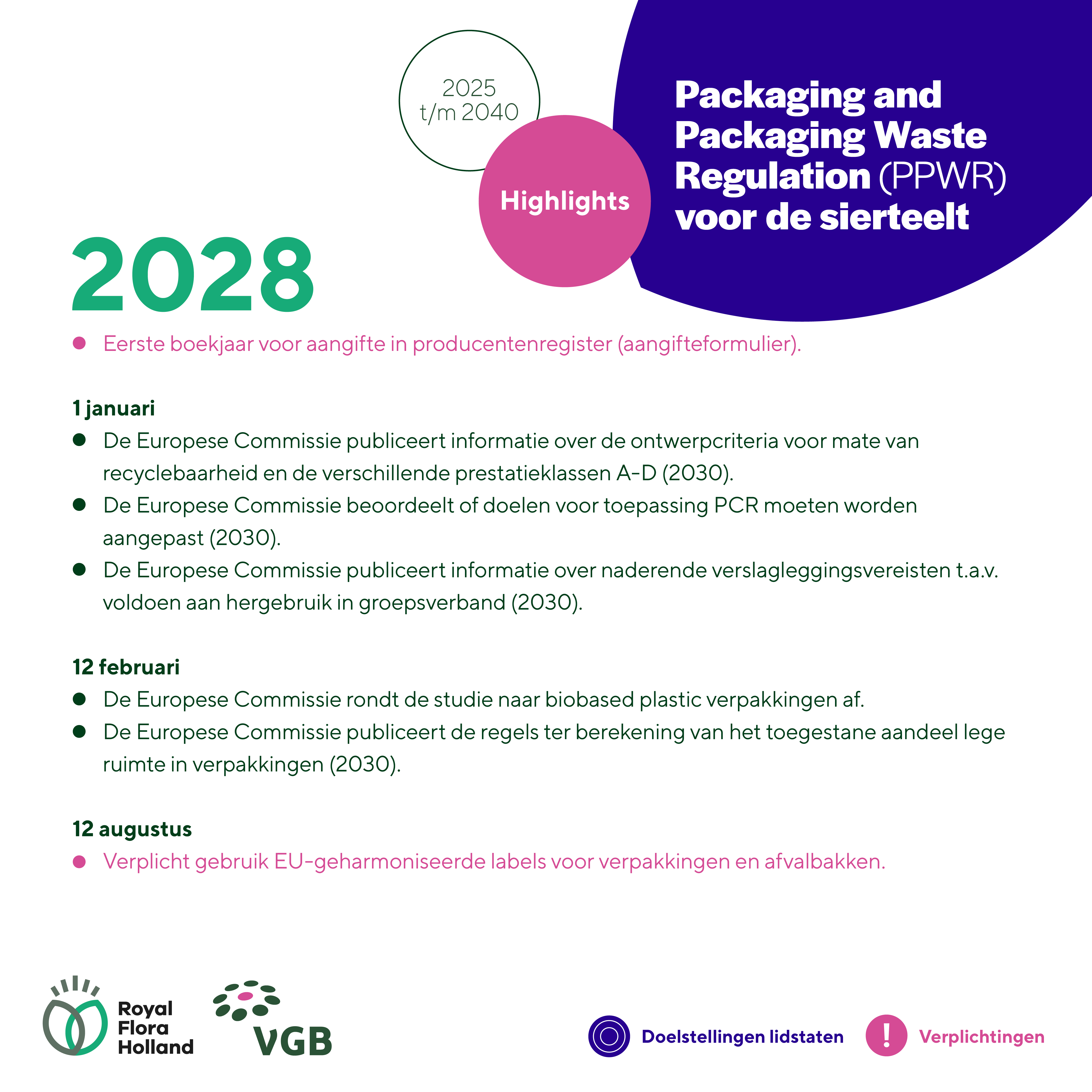
2028
First financial year for reporting to the producer register (reporting form)
1 January 2028:
- • The European Commission publishes information on the draft criteria for recyclability and the different performance classes A–D (2030)
- • The European Commission assesses whether targets for the application of PCR need to be adjusted (2030)
- • The European Commission publishes information on upcoming reporting requirements regarding compliance with collective reuse (2030)
12 February 2028:
- • The European Commission completes the study on bio-based plastic packaging.
- • The European Commission publishes the rules for calculating the permitted proportion of empty space in packaging (2030)
12 August 2028: Mandatory use of EU-harmonised labels for packaging and waste bins.
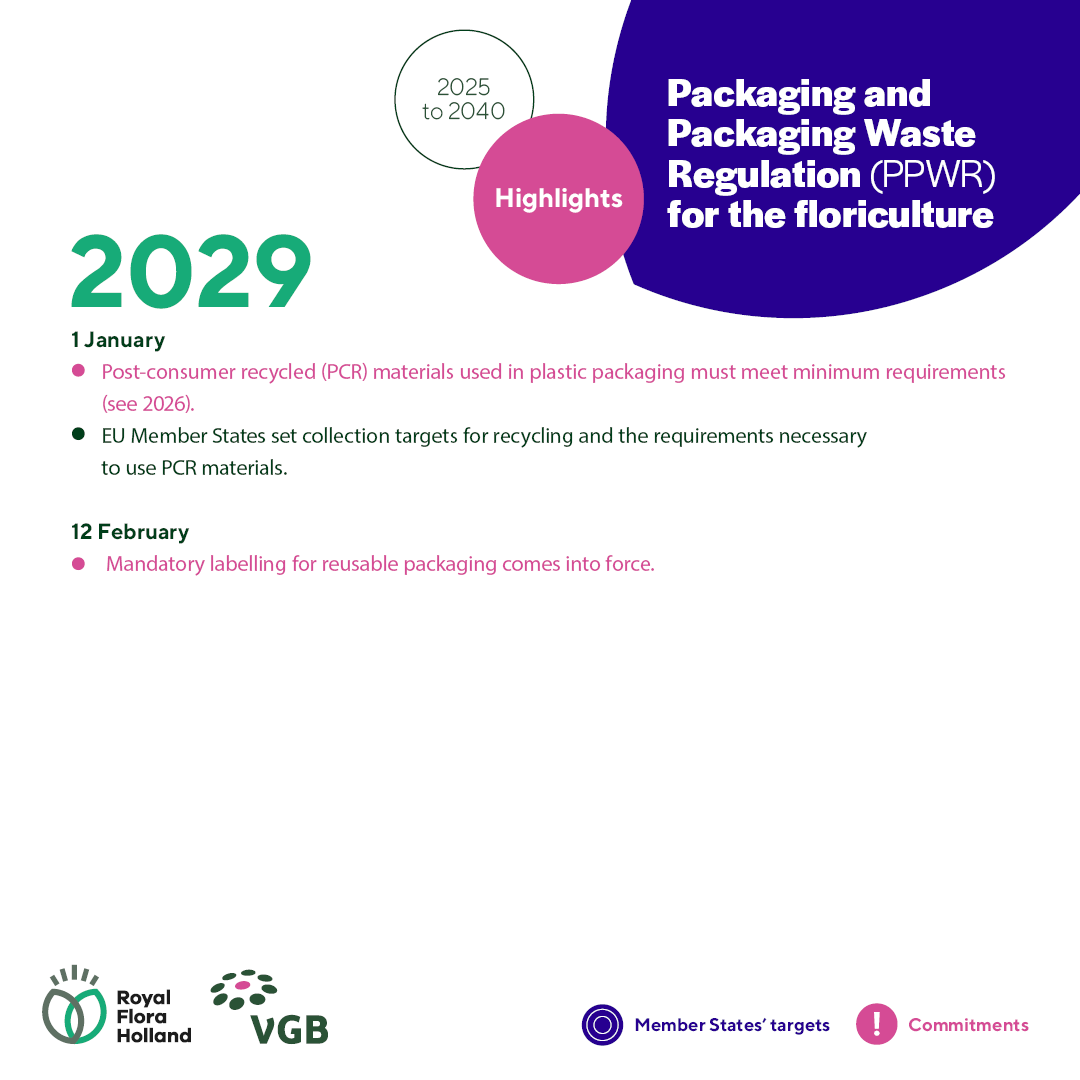
2029
1 January 2029:
- • Post-consumer recycled (PCR) materials used in plastic packaging must meet minimum requirements (see 2026)
- • EU Member States set collection targets for recycling and the requirements necessary to use PCR materials
12 February 2029: Mandatory labelling for reusable packaging comes into force.
2030
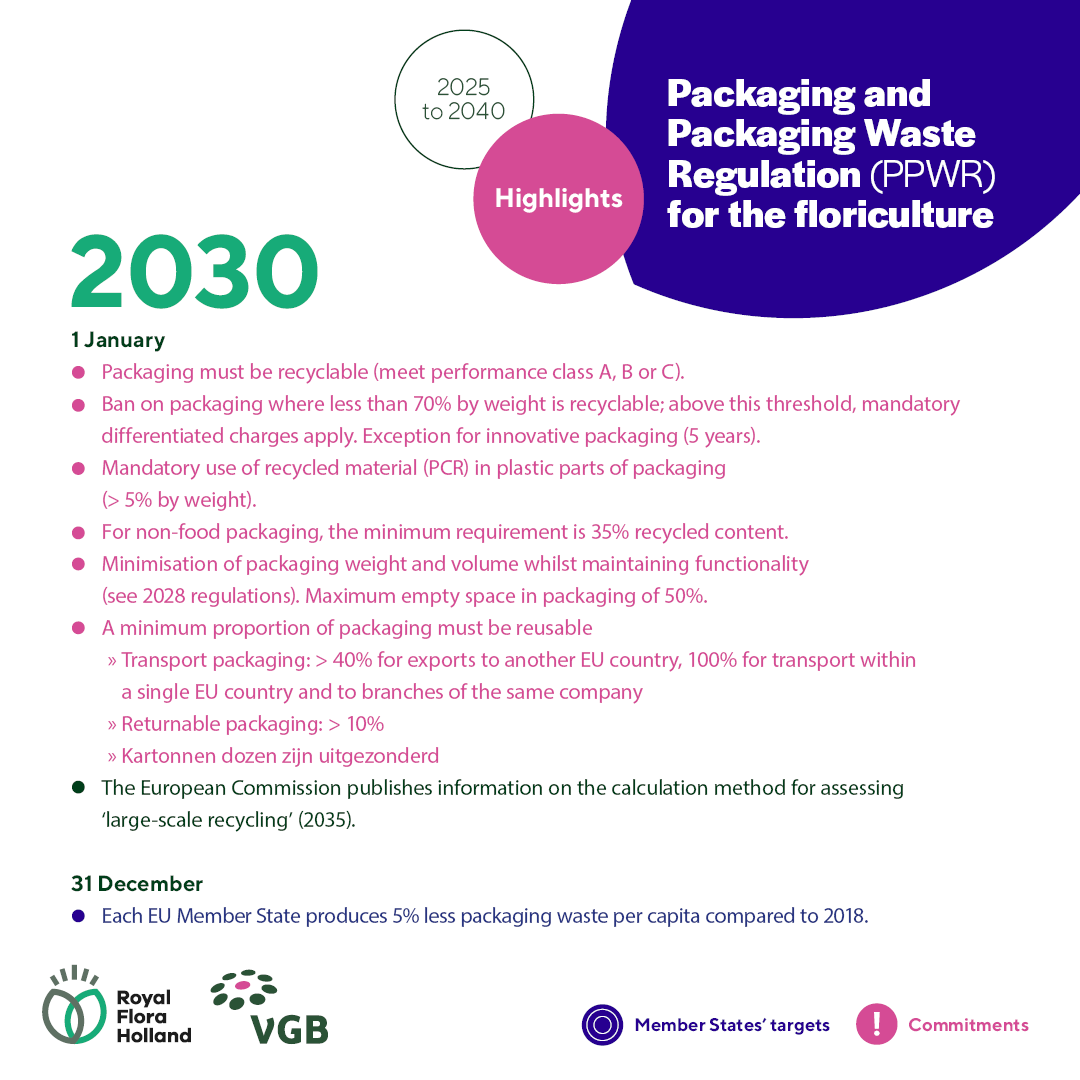
1 January 2030:
- • Packaging must be recyclable (meet performance class A, B or C).
- • Ban on packaging where less than 70% by weight is recyclable; above this threshold, mandatory differential pricing applies. Exception for innovative packaging (5 years)
- • Mandatory use of recycled material (PCR) in plastic parts of packaging (> 5% by weight). For non-food packaging, the minimum requirement is 35% recycled content.
- • Minimisation of packaging weight and volume whilst maintaining functionality (see 2028 rules). Maximum empty space in packaging of 50%.
- • A minimum proportion of packaging must be reusable
- - Packaging & transport: > 40% for exports to another EU country, 100% for transport within a single EU country and to branches of the same company
- - Multi-pack packaging: > 10%
- - Cardboard boxes are excluded
- • The European Commission publishes information on the calculation method for assessing “large-scale recycling” (2035)
31 December 2030: Each EU Member State will generate 5% less packaging waste per capita than in 2018.
2035
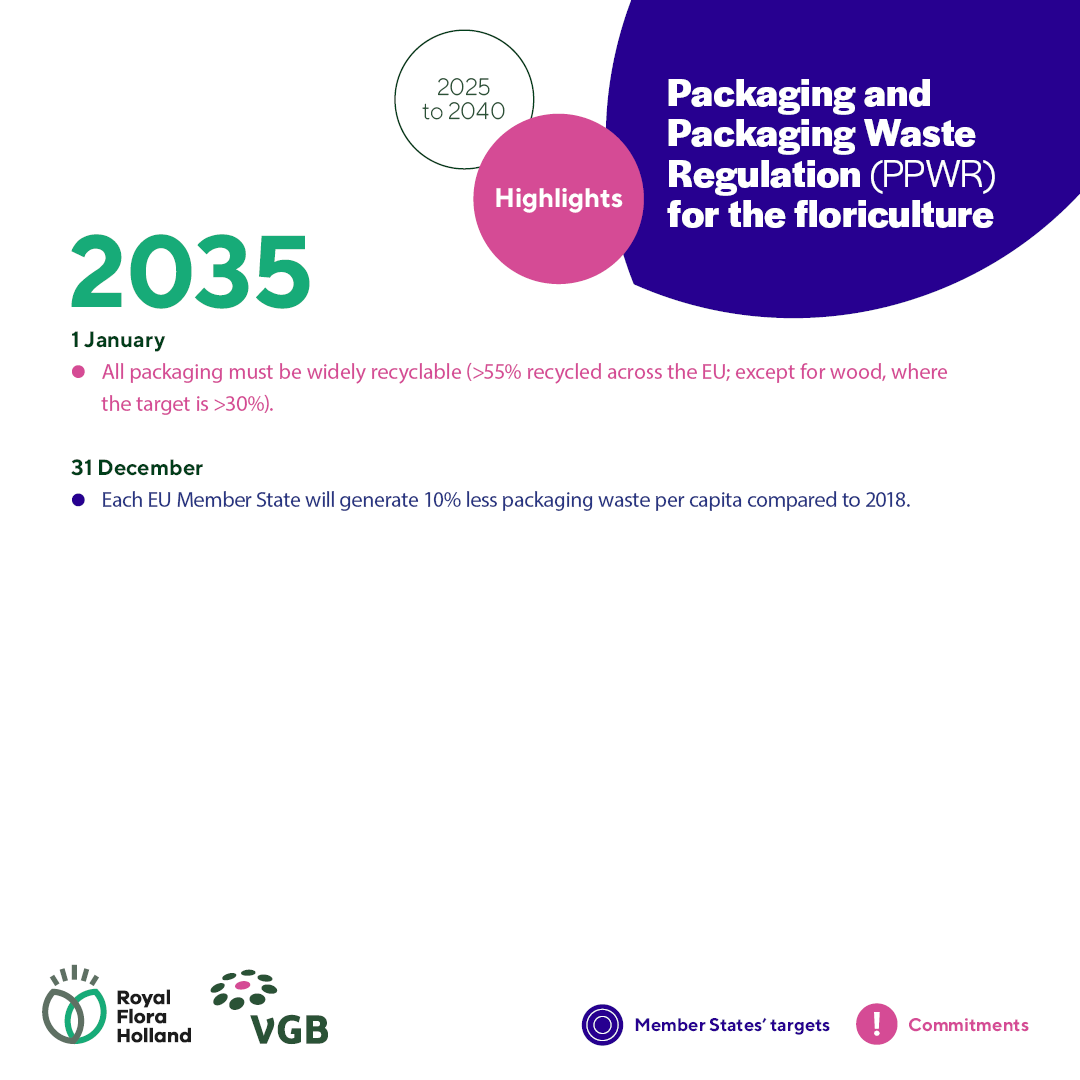
1 January 2035: All packaging must be widely recyclable (>55% recycled across the EU; with the exception of wood, where the target is >30%)
31 December 2035: Each EU Member State will generate 10% less packaging waste per capita compared to 2018.
2038
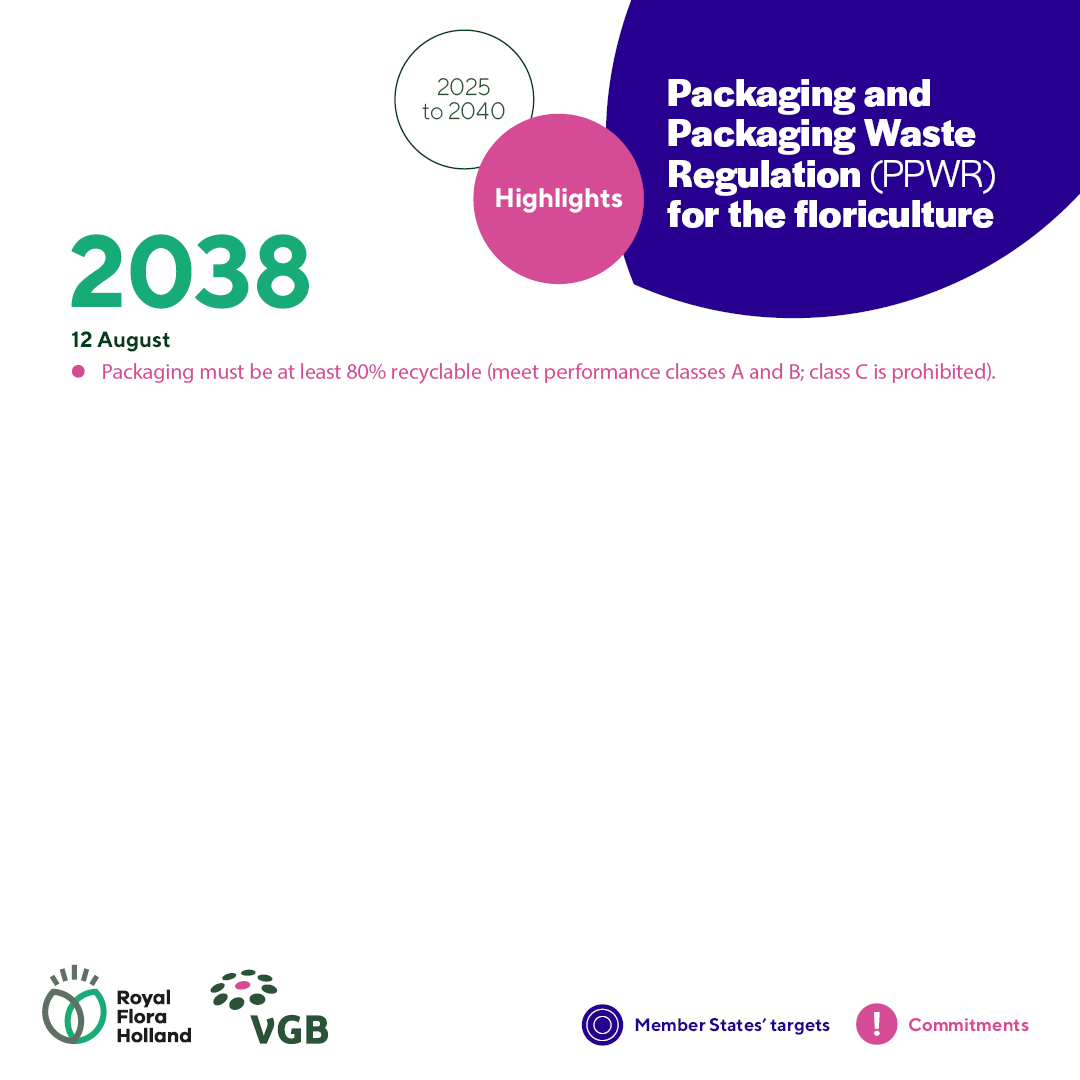
12 August 2038: Packaging must be at least 80% recyclable (must meet performance classes A and B; class C is prohibited).
2040
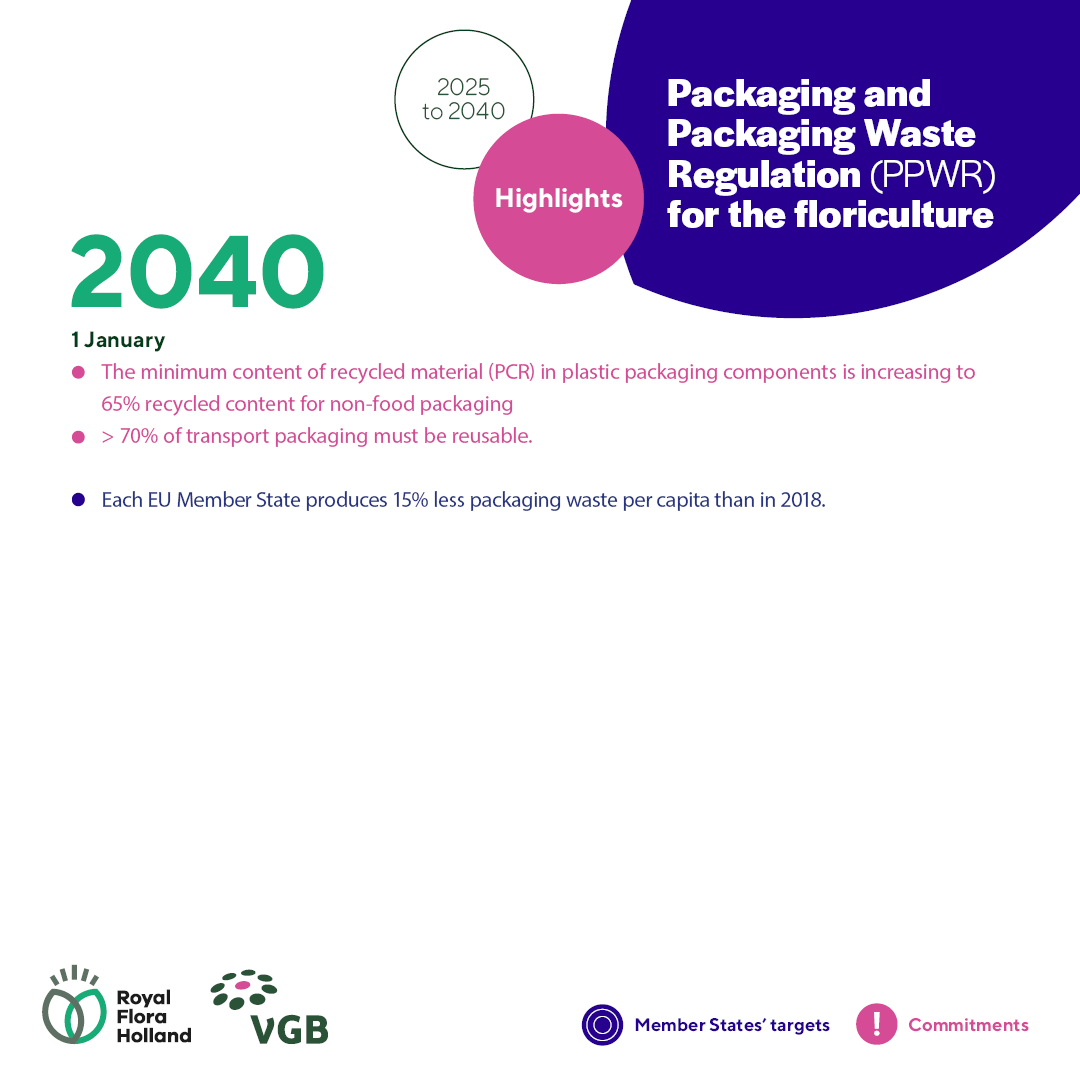
1 January 2040:
- • The minimum content of recycled material (PCR) in plastic packaging components will increase to 65% recycled content for non-food packaging
- • > 70% of transport packaging must be reusable.
- • Each EU Member State must produce 15% less packaging waste per capita compared to 2018.
The PPWR explained
The PPWR (Packaging and Packaging Waste Regulation) has been in force since 11 February 2025. The regulation introduces a number of new obligations for virtually all businesses that manufacture, use, sell or place packaging on the market. The rules are becoming stricter and more detailed, and apply across the entire EU.
What’s changing?
The EU’s Plant Protection Products Packaging Regulation (PPWR) brings significant changes for everyone working with packaging in the floriculture sector. The rules are becoming stricter and affect virtually every link in the supply chain: from growers and traders to importers, distributors and other floriculture-related service providers.
Royal FloraHolland and VGB
On this page, Royal FloraHolland and the Association of Wholesalers in Floricultural Products (VGB) will keep you informed of all developments relating to the PPWR.
In addition, Royal FloraHolland is working to make transport packaging in the floriculture chain more sustainable. In our efforts to improve sustainability, we naturally take the PPWR into account. Through smarter use of packaging, reusable packaging and more efficient logistics processes, we are reducing waste, saving raw materials and reducing our collective carbon footprint.
Useful information
Make sure you familiarise yourself with the PPWR legislation so you don’t face surprises later on.
More about the PPWR
We are happy to answer all your questions
Get in touch with us.
Disclaimer: This information is based on the most recent publicly available version of the PPWR. All provisions are subject to amendment, supplementation or further specification through delegated acts, implementing acts or other legislative procedures. Royal FloraHolland (RFH) gives no guarantee whatsoever that subsequent changes will be handled in this material.
- This presentation is intended solely to provide a general and broad overview of certain requirements under the PPWR. The content does not constitute legal advice, compliance advice, technical guidance or any other form of professional judgement, and must under no circumstances be regarded as such or relied upon.
- The information provided is not exhaustive and does not purport to give a complete, accurate or authoritative interpretation of the PPWR. For binding and up-to-date information, users should consult the official EU legislation, guidelines and other regulatory publications.
- Royal FloraHolland expressly excludes all liability, including – but not limited to – liability for direct, indirect, incidental, consequential, punitive or special damages arising out of or in connection with:
- the use of or reliance on this information;
- any inaccuracies, omissions, outdated data or subsequent changes to the PPWR;
- decisions taken or omitted on the basis of this material.
- RFH makes no warranty or representation, express or implied, regarding the accuracy, completeness, timeliness or continued availability of the information.
- Each user is solely and fully responsible for assessing the applicability and consequences of this information within their own business operations, legal obligations, compliance requirements and operational processes. The use of the information, examples or conclusions is entirely at your own risk. RFH accepts no duty of care whatsoever and is under no obligation to update, correct or supplement this material.