Impactmakers: from rose cuttings to valuable compost
July 23, 2026
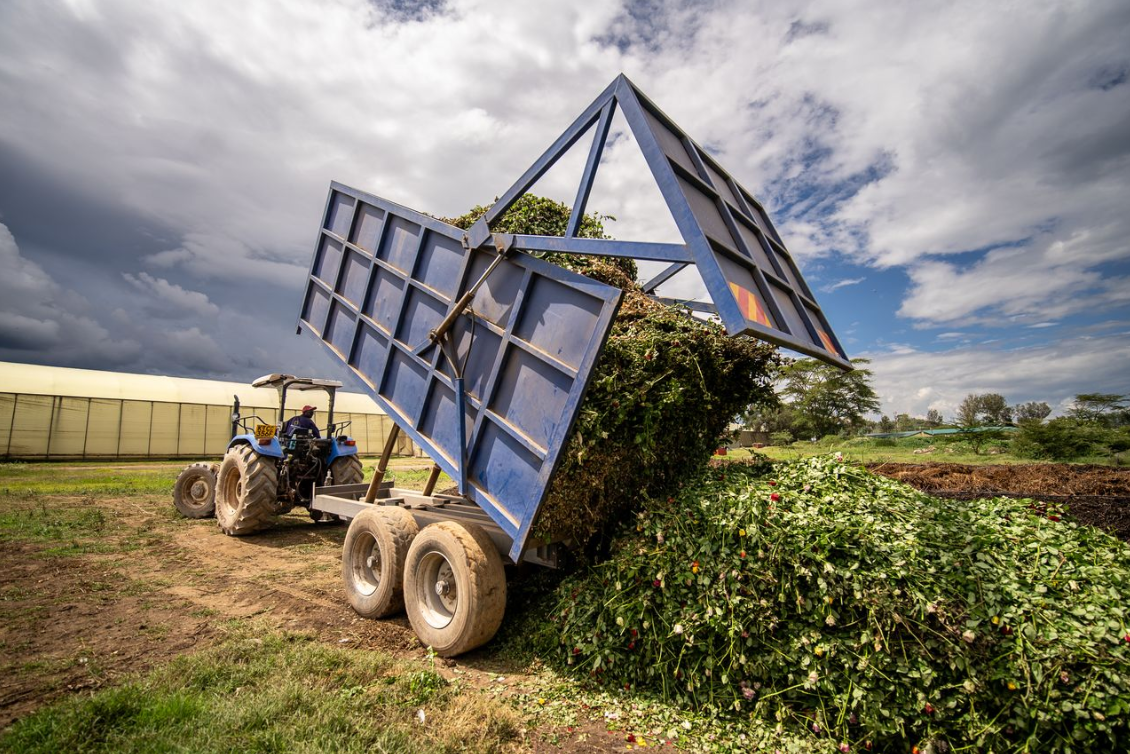
Together with entrepreneurs, we are building a sustainable future in which flowers and plants are grown with respect for people and the environment. In our ‘Impactmakers’ series, we highlight inspiring examples. Bilashaka Flowers from Kenya recently took part in a scientific study to compost and reuse rose waste directly at the nursery/farm. And what did they find? It delivers not only ecological but also economic benefits.
Joost Zuurbier and his sister Rosaline have been growing roses in Kenya since 2001. They do so on 76 hectares on the shores of Lake Naivasha, some 120 kilometres north-west of the capital, Nairobi. Every day, their workforce of over 1,400 employees harvests around 400,000 roses. According to Joost, sustainability at Bilashaka Flowers is ‘not a trend, but a deeply rooted driving force’. This stems not only from an intrinsic motivation to maintain the living and growing environment as well as possible, but also from their background in agricultural technology. “We are very interested in solving problems and continuously improving processes.”
50 kilograms of rose waste per hectare
That is why Bilashaka Flowers is investing in reusing as much water as possible and, amongst other things, in biological pest control. Given their commitment to sustainability, it was no surprise that they were open to collaborating on a PhD research project led by Evy de Nijs. Initially as a PhD student and now as a postdoctoral researcher in Earth Sciences at the University of Amsterdam, she investigated the potential of rose waste for, amongst others, Kenyan rose growers. The Zuurbier family already had experience, on a small scale, with composting rose waste and reusing it directly at the nursery/farm. To apply this on a larger scale, further knowledge was required.
A rose nursery can produce up to 50 kilos of rose waste per hectare every day. The cut leaves and stems, as well as rejected roses, have great potential. Not only for Bilashaka Flowers, but for the entire sector, both in Kenya and in the Netherlands. “Effective management of organic waste is crucial to ensuring the sustainability of cultivation,” says Evy.
What is the best way to compost?
Composting is a proven process for more clean handling of organic material. But if you want to use this compost for a rose crop that you’re planting for around ten years, you do need to do it properly. That’s why Evy spent years conducting research. “I looked into how rose waste can best be composted and how this compost can be reused within the rose cultivation cycle. The research involved a series of experiments on an increasingly large scale, during which the composting process and its practical application in rose cultivation were meticulously evaluated.”
A major challenge was achieving rapid and effective composting of the woody rose stems. This is because the stems contain lignin: a natural polymer that is difficult to break down. Initially, laboratory experiments were carried out to investigate how rose stems and lignin (wood substance) break down most effectively and what quality of compost this produces. Large-scale field trials were then set up, in which piles of rose waste weighing up to 4,000 kilos were monitored for months for temperature, moisture and decomposition processes. Finally, the compost produced was used in cultivation trials to evaluate the effects on soil quality, production and economic yield.
Ecological and economic benefits
The research demonstrated that composting contributes to both ecological and economic sustainability in rose cultivation. It was found that high-quality, mature compost can be produced within six months. For a one-and-a-half-year cultivation trial in 2022, 15 to 17 kilograms of compost per square metre were manually worked into the top 60 centimetres of soil, layer by layer. From the first harvest onwards, the number of stems and the yield by weight per square metre were recorded daily. The length and market value of the stems were also noted.
Evy: “The yield and quality of the roses in the trial beds were good. There was an increase of 3.2 to 4.7 per cent in the number of stems harvested compared with the plots without compost. This is partly due to nutrients released from the compost during the first ten months after planting. The higher organic matter content and the improved soil structure also had significant positive effects.”
Composting is therefore an efficient way to manage green waste, improve soil fertility, increase crop yields and reduce the need for artificial fertiliser. This is in line with one of Bilashaka Flowers’ specific sustainability targets: to reduce the amount of artificial fertiliser by 20 per cent over the next five years. In addition, an unexpected benefit was demonstrated: the rich microbial life in the compost actively helps to accelerate the breakdown of residues from crop protection products.
Closing the raw materials cycle for a more sustainable floriculture sector
In short: through composting, rose growers can safeguard long-term productivity and soil quality whilst achieving higher yields. “These results highlight the importance of composting in closing the raw materials cycle and promoting sustainability in horticulture,” says Evy, who continues to monitor the roses planted at Bilashaka Flowers and has observed that soil quality has improved in the long term thanks to the added compost. A follow-up study is already underway. “We are examining the effects of organic matter on the behaviour and interactions of elements in the soil – including crop protection products authorised by the EU – both in the field at various Kenyan rose nurseries and in the lab. We are also taking plant uptake into account.”
Would you like to know more about the research? Take a look here. Are you interested in contributing to Evy de Nijs’s follow-up research? Please contact her via e.a.denijs@uva.nl.
-
Did you find this interesting?
Then share this article
-
Related articles