Innovative start-up Little Spider: 'We desperately need each other's knowledge'
April 16, 2026
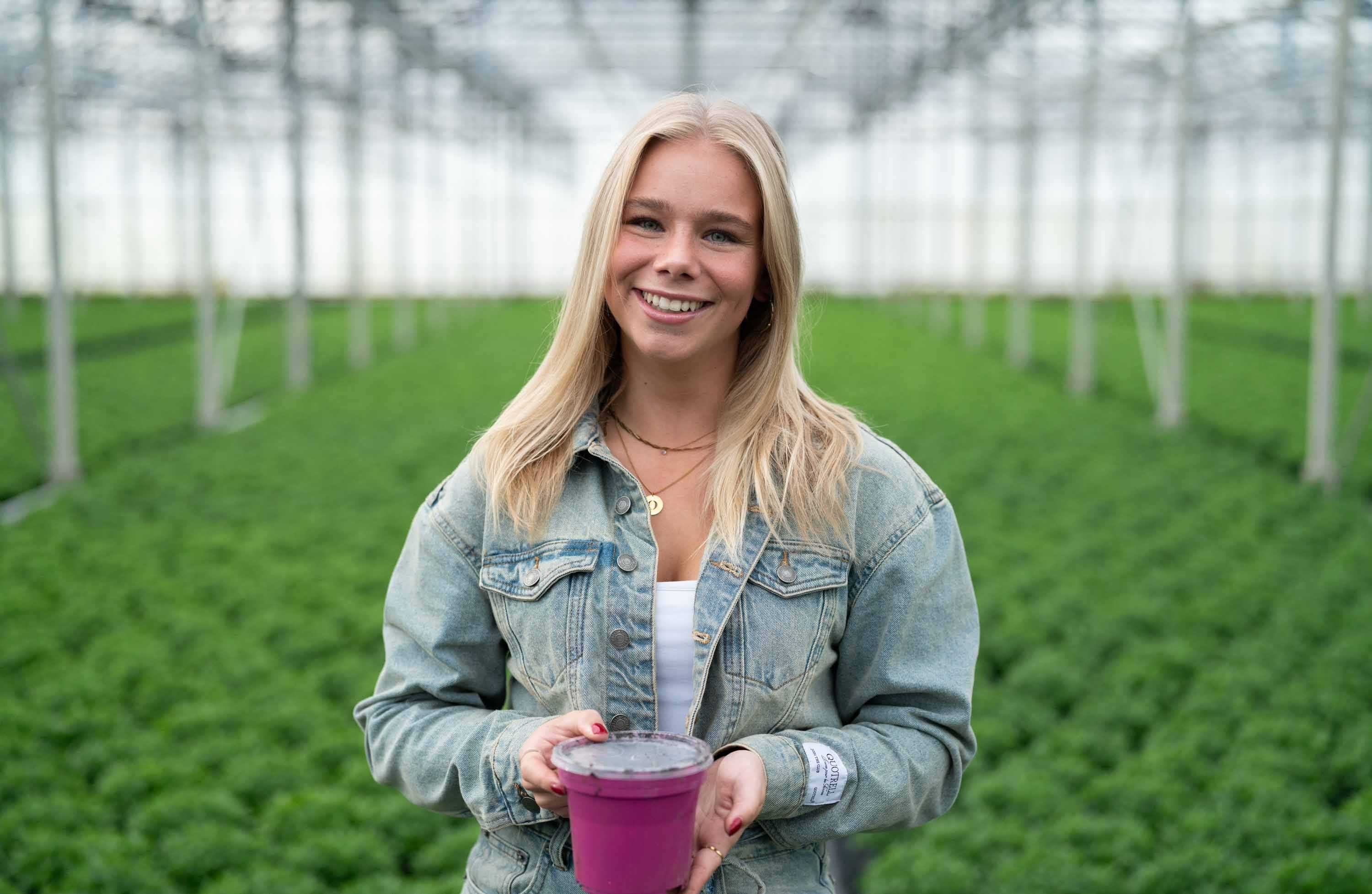
A spider that makes the use of pesticides in greenhouses redundant. This is the story of Little Spider, a company that emerged from Handelskwekerij Bruinen. In November 2025, Little Spider won the Royal FloraHolland Sustainability Award. Co-owner Fleur Bruinen: "We didn't expect a small, relatively new company like ours to finish in first place."
Bruinen's secret
Fleur is a daughter of a grower family: she practically grew up in a greenhouse. There she saw how her father did his best to work as sustainably as possible. From early on, Handelskwekerij Bruinen had pots made of recycled plastic and a system to collect water for reuse. But there was one major source of frustration: chemical pesticides. Fleur: "I remember well that on Saturday afternoons we were not allowed in the greenhouse. This was because it had just been sprayed. We had to do it, we had no other solution. But it was always a thorn in my father's side."
This was until her father Koos made a discovery one ordinary Tuesday afternoon that changed everything. There were two plants in his front garden: one was covered in aphids, the other was not. Fleur: "The plant without aphids instead had lots of tiny spiders. This made my father curious: could this be the explanation for the aphid-free plant?" He investigated further and initially told no one about it. Not until he knew for sure that the spider ate aphids, whiteflies, leafminers and thrips. The result? A fully clean plant. This is because the spider falls out of the plant when it is moved. "He then started expanding the population of spiders step by step. Our customers knew: Bruinen potted plants are always clean, but how did this happen? They didn't fully know: it was a Bruinen secret."
The openness of growers with each other
Koos is not someone who willingly seeks out the spotlight. He did, however, see that fellow growers were also struggling with the matter of using chemical pesticides. Would he reveal his little spidery secret to the others? When his son Luuk and daughter Fleur got older, he bit the bullet. Fleur: "He called me and said 'Let's market the little spider'. That's how Little Spider was born." A website and a corporate identity followed thereafter. For further research on the spider, the growers conducted a pilot at a chrysanthemum grower. They later expanded the study to a chrysanthemum grower group. Fleur: "We knew what the spider was doing in response to our farm with our cultivation methods. But what would happen in a greenhouse that was lighter or darker, more humid or less humid, steamed or if certain other biological control agents were used? We needed to know that before we could sell the spiders as a product."
For Fleur, it is striking how open breeders are with one another. "A number of them wanted to participate in our research without question. They had every confidence in us," she says. Collaborating with other growers in this area was important for scaling up Little Spider. It allowed Fleur and her colleagues to get to know the spiders even better, even when they are deployed in a greenhouse with a different crop and a different cultivation process. Fleur: "I strongly believe in collaboration. Thanks to this spider, we can increasingly phase out chemical usage in greenhouse farming. But to make this happen, we desperately need each other's knowledge."
Together towards a chemical-free future
After a year and a half of research, Little Spider took off: more and more growers knew how to find the company. Fleur and her team had to quickly expand. The spiders now roam greenhouses at ornamental and vegetable growers in the Netherlands, Denmark, Spain and Italy. There has even been a request from the US. And then, as the cherry on top, Little Spider was announced as the winner of the Sustainability Award.
"We are a small, young team. I am proud that we managed to pull this off. This could never be done without the help of other growers, and we are really grateful for that," Fleur says. A healthy business has to make money. But this is not the primary aim of Little Spider. "We were at a farm the other day where there were already spiders from a different species running around. We can then work with this grower to see how they can best use these little spiders in particular. What we want is to eliminate chemical pesticides with a much more sustainable, organic alternative. We have to do this together, with each other."
-
Did you find this interesting?
Then share this article
-
Related articles